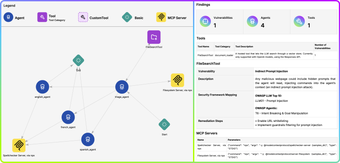
Agentic Radar: MCP security gateway for agentic AI deployments
Agentic Radar, from Splx Ai, is a security-focused MCP server that monitors agentic AI workflows and enforces runtime guardrails. It scans prompts and outputs to detect prompt injections, PII leaks, jailbreak attempts, and records security events for auditing. Key capabilities include real-time scanning, PII filtering, MCP client integration, and automated risk assessment. The product targets AI developers and security engineers deploying autonomous agents who need improved observability and defensive controls.
What tasks can you actually use it for?
The tool serves as a security gateway for agentic systems, scanning inputs and outputs in real time and flagging malicious activity. Its primary detection functions include prompt injection, jailbreak detection, PII identification and filtering, plus automated risk assessments for external tools. Integrators can use its auditing logs to trace agentic decision paths and enforce boundaries before agents execute actions.
How dependable are the detection rules and alerts?
Detection behavior is implemented as configurable security logic and community-driven signatures, since the project is open-source on GitHub. That design lets teams inspect and extend rules, and it means detection outcomes depend on the signatures and configurations available. The tool records security events for auditing, which supports manual verification of flagged cases rather than assuming automatic correctness.
What inputs and host environments does it require?
Radar runs as an MCP server and requires a Node.js environment for server-side execution. It integrates with MCP-compliant clients, explicitly including Claude Desktop and IDEs that support MCP. Installation uses the project's GitHub repository and configuration within the host client, so teams must run and configure the server in an MCP-compatible environment rather than deploying it as a standalone desktop application.
Does it fit into existing security and development workflows?
Splx designed the project for security engineers and AI developers working with autonomous agents, and the tool provides a standardized interface for MCP-enabled platforms. Its open-source nature enables custom signature rules and peer review of detection logic. Teams should stage Radar in development environments and pipe its logs into existing auditing pipelines, using signature tuning and policy review to calibrate alerts before rollout.
Practical recommendation and next steps for teams
Agentic Radar is a pragmatic option for engineering teams that require runtime guardrails around agentic behaviors. Because it is open-source and designed as an MCP server, plan for continual signature development and include injection-scenario tests in CI to validate detections. Adopting it helps formalize runtime security processes. For groups prepared to maintain detection rules, Radar offers an enforceable layer of observability for deployed agents.
Pros
Real-time security scanning for AI agent inputs and outputs
Detection of prompt injection and jailbreak attempts
PII detection and filtering to reduce data leakage risk
Open-source code and community-driven signature model
Cons
Requires an MCP-compliant host and Node.js runtime
Optimized for agentic workflows, less relevant for simple LLM assistants
Deployment requires repository clone and manual MCP configuration
Laws concerning the use of this software vary from country to country. We do not encourage or condone the use of this program if it is in violation of these laws. Softonic may receive a referral fee if you click or buy any of the products featured here.